
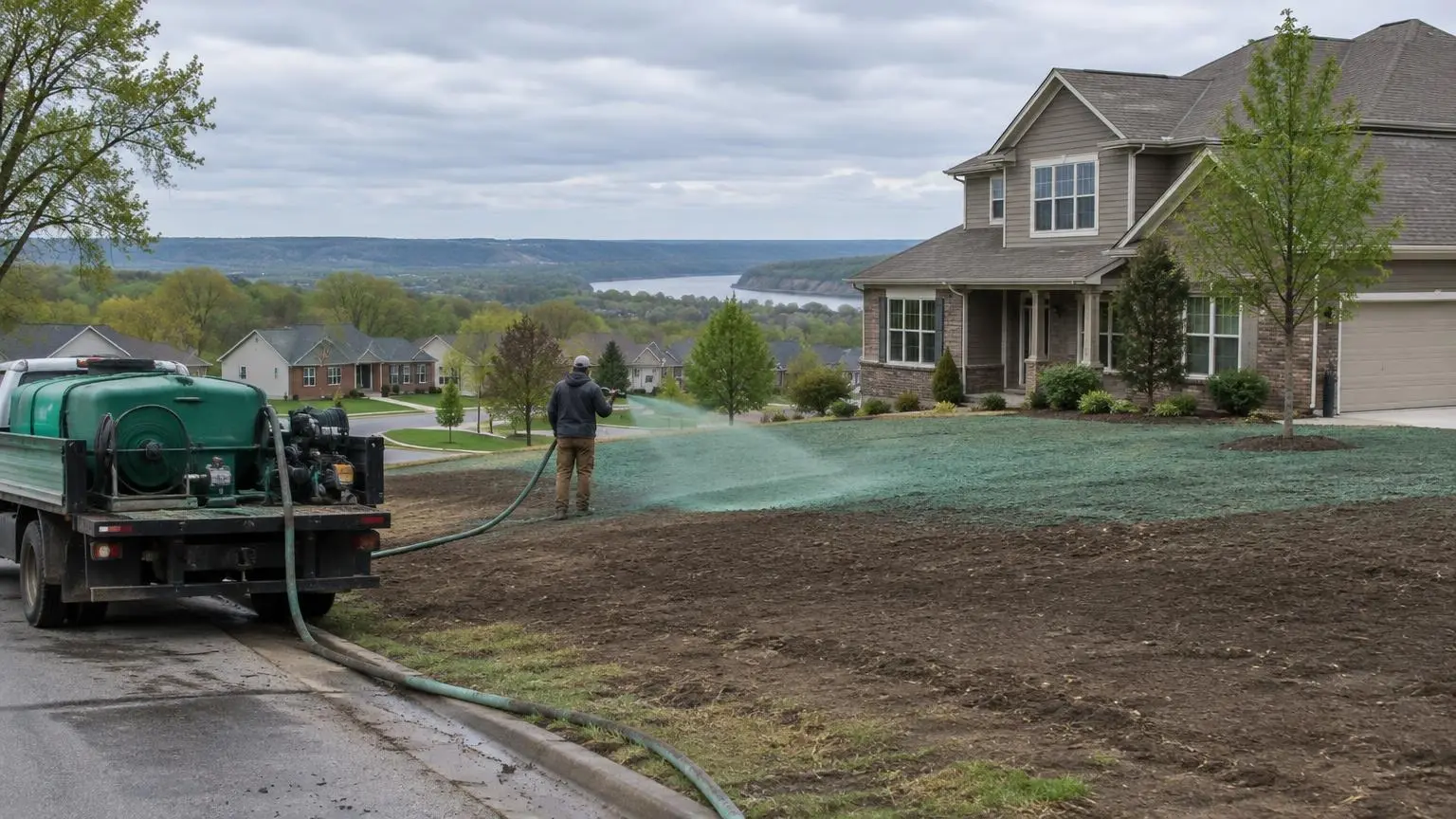
From cropland to cul-de-sacs
Hydroseeding in Olathe, KS
Much of Olathe's newer housing sits on ground that grew crops a generation ago.
- We walk your ground for free and quote it in writing
- Seed mixes chosen for Missouri's transition-zone weather
- Grading, seeding and erosion control from one crew
Turning Old Fields Into Lawns
Hydroseeding in Olathe usually starts on ground that was farmland not long ago. After Interstate 35 tied the city to Kansas City, Missouri, Olathe saw tremendous residential growth, and later building spread into farm fields to the south, west and north of town. Old cropland can grow good grass, but construction leaves it packed down and stripped in places.
What construction does to field soil
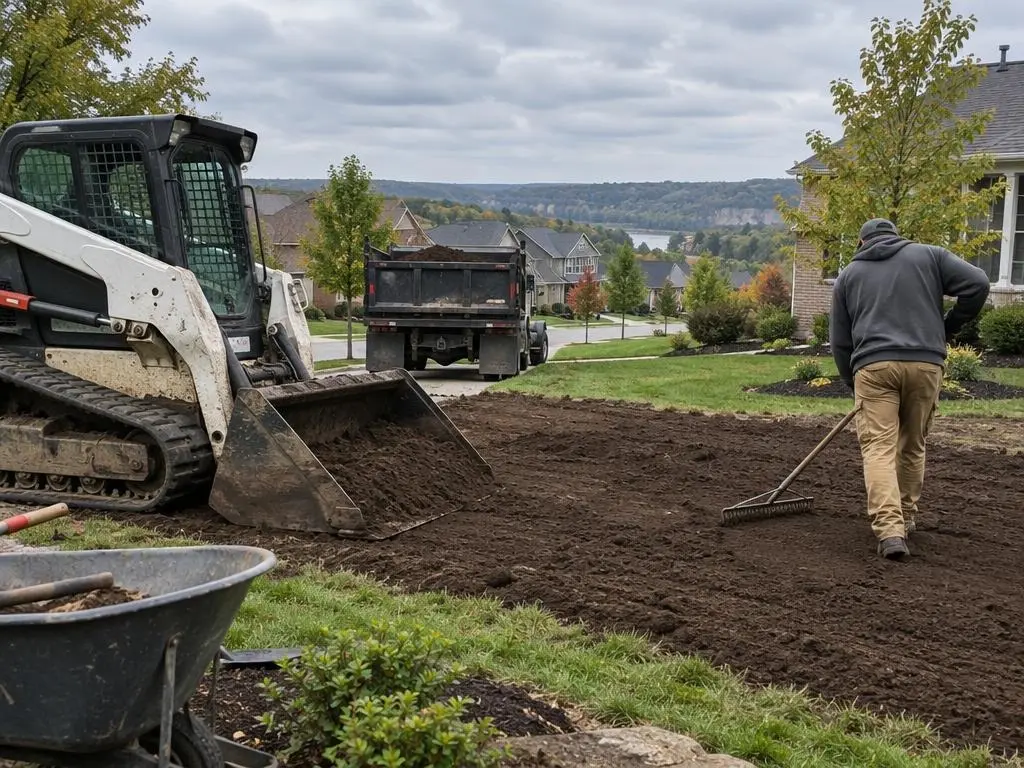
The loess soils common in this part of Kansas, such as the Sharpsburg series that the USDA maps in Kansas and Missouri, have silt loam or silty clay loam surfaces. Those textures compact under heavy equipment and crust after rain. Before seeding, we loosen packed areas, bring in topsoil where the builder cut too deep and fine grade so runoff drains away from the foundation.
Frost dates set the calendar
Olathe's first frost usually comes between mid-October and the first week of November, and the last frost between late March and the second week of April. For a fescue lawn we aim for late August through September, which leaves several weeks of rooting before cold nights.
A higher city
At about 1,037 feet, Olathe sits higher than Kansas City's river bottoms, and its lots are generally gentler. That makes most new lawns straightforward, but drainage swales between houses still carry a lot of water in a storm. We line swales with blanket or heavier mulch so they do not wash before the grass fills in.
Builder and HOA work
With 51,820 housing units counted in 2020, there is steady work on spec homes, model lots and common areas. We seed commercial strips, detention basins and HOA entrances, and install silt fence where a site needs sediment control.
Get a free estimate or call (816) 666-9542.
Olathe Facts That Affect Your Lawn
- Growth into farmland. Later growth extended into farm fields south, west and north of the original town.
- Frost dates. First frost usually arrives mid-October to early November; last frost late March to the second week of April.
- Precipitation. The city's climate table lists about 40.73 inches of precipitation a year.
- Lakes. Lake Olathe has 172 acres of water surface, and Cedar Lake covers 45 acres.
Olathe Questions
My new Olathe home sits on an old farm field. Is the soil any good?
The original soil is often fine, but construction compacts it and sometimes buries it. We loosen and add topsoil where needed before seeding.
Why does water pool between my house and the neighbor's?
The swale may have settled or been graded flat. We can regrade it and protect it with blanket before seeding.
Is it too late to seed in October?
Early October can still work for fescue in a mild year. Later than that, we usually suggest waiting for spring.
Do you seed HOA common areas and detention ponds?
Yes, along with commercial strips and builder lots.
Free Estimates in Olathe, KS
Free estimates for Olathe new builds, swales and common areas.
Hydroseeding Near Olathe
- Hydroseeding in Kansas City, MO
- Hydroseeding in Overland Park, KS
- Hydroseeding in Lee's Summit, MO
- Hydroseeding in Kansas City, KS
- Hydroseeding in Independence, MO
- Hydroseeding in Blue Springs, MO
- Hydroseeding in Shawnee, KS
- Hydroseeding in Lenexa, KS
- Hydroseeding in Liberty, MO
- Hydroseeding in Raymore, MO
- Hydroseeding in Gardner, KS
- Hydroseeding in Leawood, KS
- Hydroseeding in Belton, MO
- Hydroseeding in Grandview, MO
- Hydroseeding in Gladstone, MO
- Hydroseeding in Parkville, MO
- Hydroseeding in Smithville, MO
- Hydroseeding in Kearney, MO
- Hydroseeding in Grain Valley, MO
- Hydroseeding in Platte City, MO
- Hydroseeding in Riverside, MO
- Hydroseeding in Prairie Village, KS
- Hydroseeding in Bonner Springs, KS