
Seed, mulch and soil work for KC ground
Hydroseeding in Kansas City, MO
New lawns, steep banks and construction sites seeded for a transition-zone climate and loess soil that washes when it is bare.
- We walk your ground for free and quote it in writing
- Seed mixes chosen for Missouri's transition-zone weather
- Grading, seeding and erosion control from one crew
Why Seed Fails Here, and How We Keep It From Failing
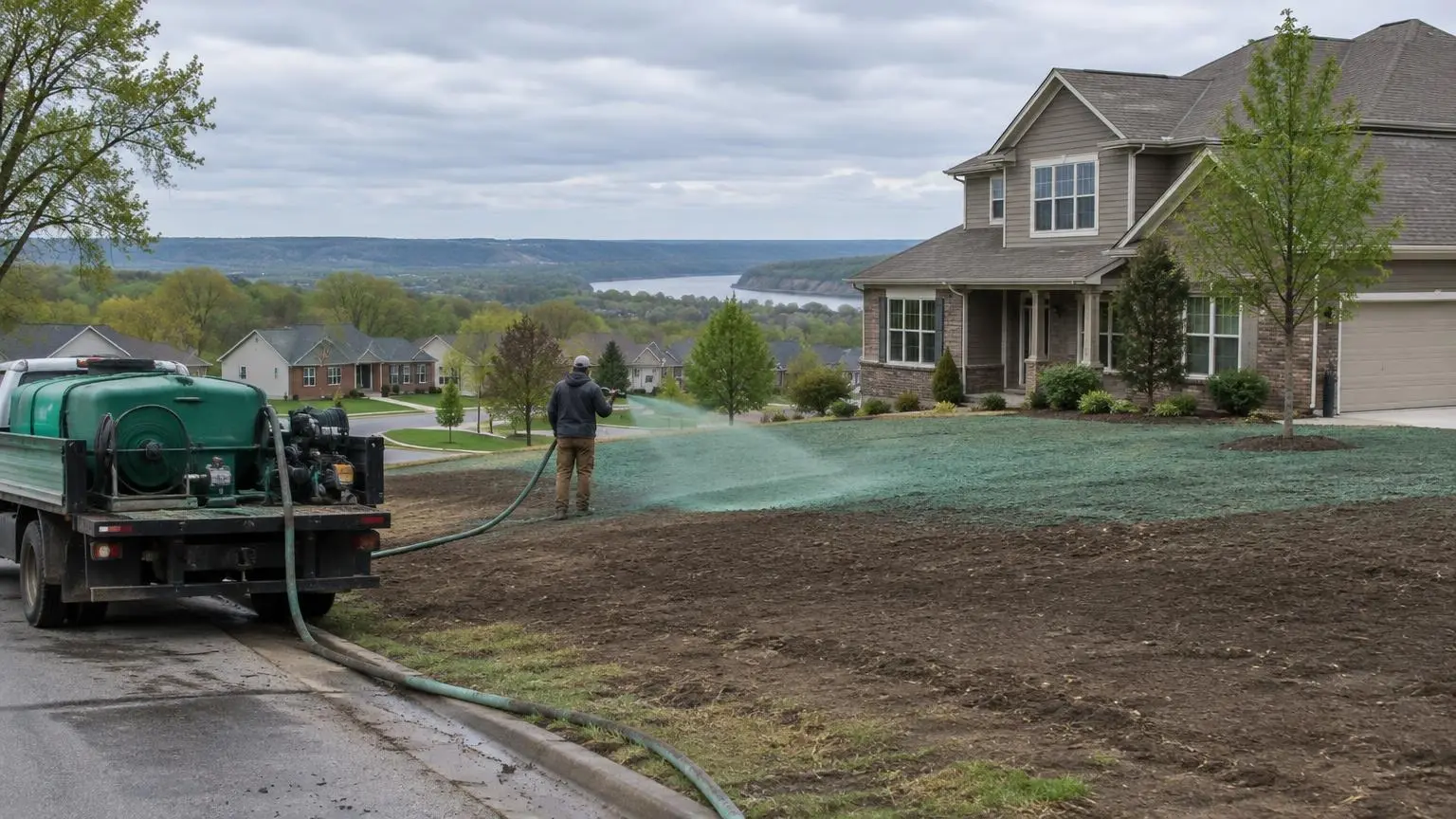
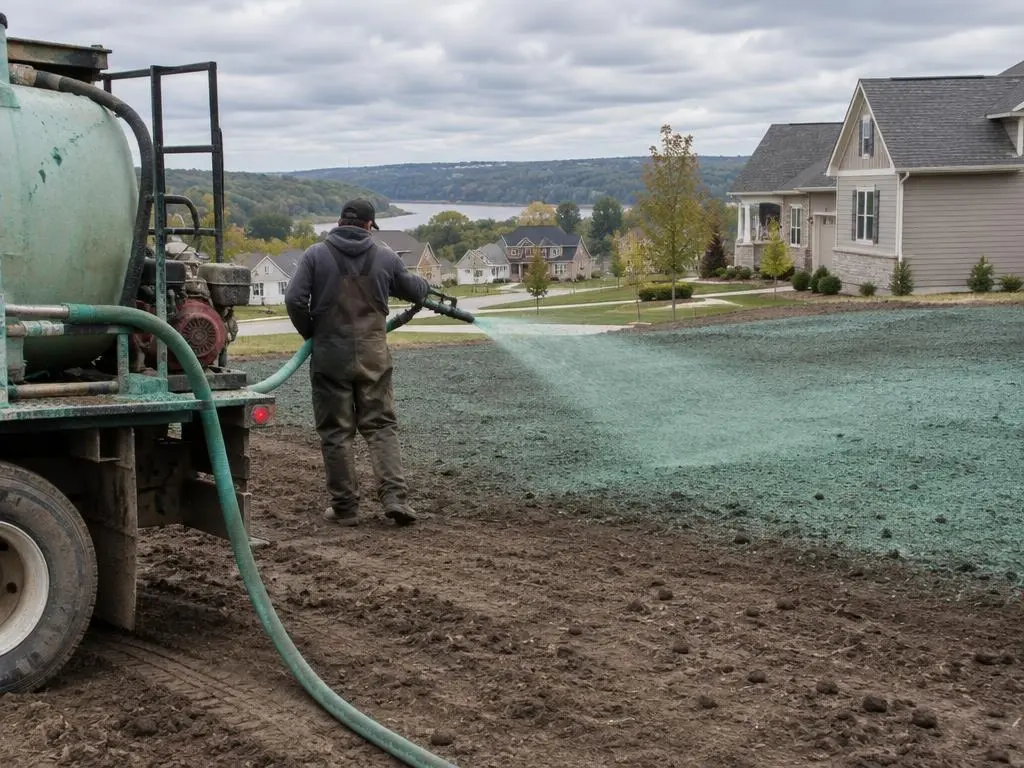
Hydroseeding in Kansas City is a race against two things: summer heat and spring rain. Our truck covers prepared soil with a tank mix of seed, fertilizer, wood fiber mulch and a tackifier, and that green layer holds moisture and keeps the seed in place while it sprouts. The method goes by a few names (hydro seeding, hydro mulching, spray seeding), and our hydroseeding services use it to put down new lawns, cover graded lots and stabilize slopes from the river bluffs to the newer suburbs in Johnson, Cass, Clay and Platte counties. It works well here, but only when the seed, the mulch and the timing match local ground and local weather.
The ground under a Kansas City lawn
Much of the upland around the city formed in thick loess, wind-blown silt laid down after the glaciers. The USDA's Sibley series, first described in Jackson County and mapped widely along the Missouri River in west-central Missouri, is a good example: very dark brown silt loam on top, with the dark layers running 20 to 26 inches deep in an undisturbed profile. Below that sits silty clay loam averaging 30 to 35 percent clay in its upper part. Sibley ground sits on ridgetops and side slopes of 2 to 14 percent, and runoff from it is rated medium to moderately rapid. Sharpsburg and Knox soils share the same kind of landscape.
That dark topsoil is why old prairie here grew so well. The problem is that new construction often scrapes it off or buries it. A lot that has been cut and filled may have only that sticky, lighter subsoil at the surface. It seals over after a rain, sheds water instead of soaking it in, and dries hard. Seed sprayed on it will sprout, then struggle. Before we price a new lawn, we dig a few test spots to see what is actually there.
Bluffs, ravines and the bowl
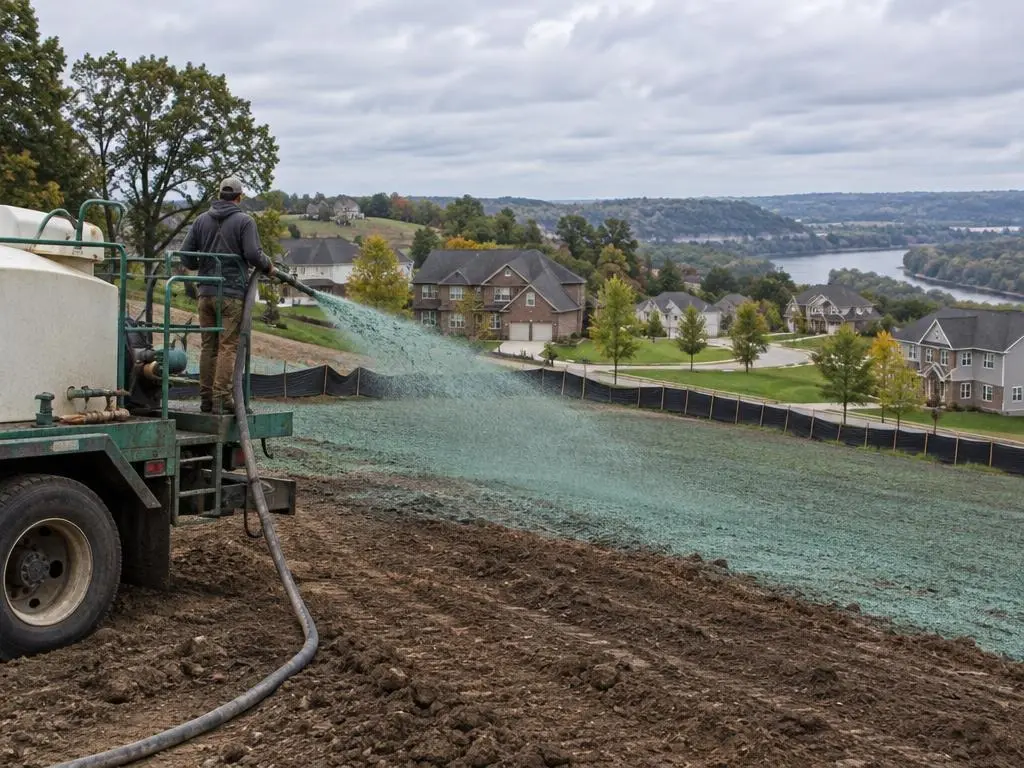
Kansas City sits where the Kansas River meets the Missouri. Bluffs overlook the river bottoms, the core of the city is shaped like a bowl, and limestone and bedrock cliffs carved during the glaciers ring it to the north and south. A partly filled spillway valley even crosses the middle of town. For seeding, that means a lot of yards with a bank, a ravine edge or a backyard that drops toward a creek. Flat sections can take a standard lawn mix and mulch. Slopes need more: a heavier hydromulch, a bonded fiber matrix, or straw or coir erosion control blankets pinned in place before seeding. Getting that slope stabilization call right is the difference between grass and a gully.
Rain that arrives in bursts
Kansas City International averages 39.30 inches of precipitation a year, and the heaviest months are May and June, each with more than five inches on average. Precipitation in both amount and frequency climbs through late spring and summer. Thunderstorms can drop that water fast on soil that has nothing growing in it yet. Hydromulch is sprayed on as a continuous mat that sticks to the surface, so it holds up far better in a hard rain than dry seed scattered over raked dirt or seed covered with loose straw. It is not a cure-all, though. Concentrated water off a roof, a driveway or a neighbor's yard will cut through any mulch, so we trace where that runoff starts and fix the grade or divert it before we spray.
When to seed: tall fescue and the fall window
The University of Missouri Extension puts the state in the turfgrass transition zone and calls turf-type tall fescue the most suitable lawn grass for Missouri, often blended with a small share of Kentucky bluegrass. Its guidance is blunt about timing: seeding a cool-season lawn in April or May is often a losing proposition, because the young grass meets summer heat before it has roots. Seeding around mid-September gives the grass a full fall and the next spring to establish. Our seeding calendar follows that.
- Late August through September: the strongest window for tall fescue lawns.
- October: still workable for many lawns. Freezing nights typically start around October 31, so later jobs carry more risk, and we may add a temporary cover grass on construction ground.
- Spring: possible once nights stay above freezing (the average last freeze is around April 4), but plan on careful watering through the first summer.
- Mid-May to early June: the window for warm-season grasses such as bermudagrass or buffalograss. Meyer zoysia, the most common warm-season lawn in Missouri, is not sold as seed and has to be sodded or plugged.
Hydroseed, sod or dry seed?
Homeowners usually weigh three options. Sod puts a finished lawn in place the day it is laid and is the right call when you need grass on a fixed date. It costs the most, and the rolls are grown elsewhere and set on top of whatever soil you have. Dry seed from a spreader is the cheapest way to cover ground, but birds, wind and rain take a share of it, and University of Nebraska Extension notes it can take two to three weeks before you see grass. Hydroseed sits in between on cost for lawn and grass seeding. The University of Nebraska describes its price as slightly above dry seeding and usually below sodding, and hydroseeded grass usually becomes visible in 5 to 7 days. The mulch keeps seed moist and in contact with the soil, which matters a lot in a Kansas City spring. You can also pick the seed mix for your sun and shade instead of taking what a sod farm grows.
Stormwater rules on building sites
For builders and developers, seeding is also a compliance step. Under federal rules, any construction disturbing an acre or more needs a Clean Water Act stormwater permit, and so does a smaller disturbance that belongs to a bigger plan of development. Those rules also require disturbed areas to be stabilized right away once work stops for more than 14 days. In Missouri, that coverage comes through the state's land disturbance general permit, issued by the Department of Natural Resources. Cities add their own layer: Liberty, for one, judges erosion and sediment controls against the KC APWA and MARC manual of best management practices. When a job begins we set silt fence and protect the inlets, then return with hydroseed or blankets for temporary and final stabilization.
What happens on a job
We visit, measure and test the soil, then send a written estimate. On seeding day we fix ruts, fine grade, add topsoil where it is missing, and spray an even coat of slurry tinted green so we can see every inch is covered. You get written watering instructions. Most hydroseeded lawns need light watering a few times a day through the first three weeks, and the first mowing is typically four to six weeks out from seeding day. If an area washes or comes in thin, call us and we will look at it.
Two States, One Metro
We seed and stabilize ground across Kansas City and the suburbs on both sides of State Line. On the Missouri side that includes Independence, Lee's Summit, Blue Springs, Grain Valley, Raymore, Belton and Grandview to the east and south, and Liberty, Gladstone, Kearney, Smithville, Parkville, Riverside and Platte City north of the river. In Kansas we work in Overland Park, Olathe, Lenexa, Shawnee, Leawood, Prairie Village, Gardner, Bonner Springs and Kansas City, Kansas. The work changes from place to place. River-bottom towns deal with flood-plain soils and high water, the bluff towns with steep yards, the fast-growing southern and eastern suburbs with freshly graded lots, and the older inner-ring cities with tired lawns that need renovation more than a fresh start. Each town page explains what we watch for there.
- Hydroseeding in Kansas City, MO
- Hydroseeding in Overland Park, KS
- Hydroseeding in Olathe, KS
- Hydroseeding in Lee's Summit, MO
- Hydroseeding in Kansas City, KS
- Hydroseeding in Independence, MO
- Hydroseeding in Blue Springs, MO
- Hydroseeding in Shawnee, KS
- Hydroseeding in Lenexa, KS
- Hydroseeding in Liberty, MO
- Hydroseeding in Raymore, MO
- Hydroseeding in Gardner, KS
- Hydroseeding in Leawood, KS
- Hydroseeding in Belton, MO
- Hydroseeding in Grandview, MO
- Hydroseeding in Gladstone, MO
- Hydroseeding in Parkville, MO
- Hydroseeding in Smithville, MO
- Hydroseeding in Kearney, MO
- Hydroseeding in Grain Valley, MO
- Hydroseeding in Platte City, MO
- Hydroseeding in Riverside, MO
- Hydroseeding in Prairie Village, KS
- Hydroseeding in Bonner Springs, KS
Why Homeowners Call Hydroseeding Kansas City
Soil checked first
We dig test spots before pricing a lawn, so you know whether a new build left real topsoil or only subsoil.
Mulch matched to grade
Flat yards, banks, swales and ditch lines each get the mulch or blanket that fits how water moves across them.
Calendar honesty
If spring seeding a tall fescue lawn is a gamble on your site, we say so and offer to stabilize now and seed in the fall.
One crew from dirt to grass
Grading, topsoil, silt fence and seeding come from the same crew, so nothing is lost between trades.
Common Questions
Is October too late to hydroseed in Kansas City?
Not always. Early October still gives tall fescue some growing time, but freezing nights typically begin around October 31, so seedlings have less time to root. For lawns we prefer late August through September. For construction sites that must be covered before winter, we can seed in October and add a temporary cover grass or blankets.
What grass should I plant in a Kansas City lawn?
For most sunny and partly shaded yards, a turf-type tall fescue blend, sometimes with a little Kentucky bluegrass. The University of Missouri Extension rates tall fescue the most suitable lawn grass in the state. If you want a warm-season lawn, bermudagrass can be seeded in late spring, but zoysia usually has to be sodded or plugged.
Roughly what does a hydroseeded yard cost in Kansas City?
National cost guides disagree. HomeAdvisor gives a typical range of $650 to $2,200 with $1,000 as the average, and HomeGuide puts it at $0.12-$0.35 a square foot. Slopes, soil prep and access shift those figures, and the amount you pay is the one on the written quote we give you after walking the yard.
What are the disadvantages of hydroseeding?
It is not instant. You will water for several weeks and wait about four to six weeks before mowing, and seeding outside the right season raises the risk. It also needs decent soil underneath; slurry cannot fix compacted subsoil or a yard that funnels water. Sod is faster, and dry seed is cheaper.
Will a heavy storm wash my new hydroseed away?
A standard mulch holds well in ordinary rain on gentle ground. A downpour concentrated off a roof or a steep bank can still cut channels. That is why we fix drainage first and use heavier mulch, bonded fiber matrix or blankets on slopes.
Do I need to remove my old lawn before hydroseeding?
If the yard is mostly weeds or bare, yes: we strip or kill the old growth, loosen the soil and fine grade before spraying. If a decent lawn is just thin, overseeding after aeration is often the better and cheaper choice.
How much watering does a hydroseeded lawn need?
Short, light waterings for about the first three weeks so the mulch never dries out; when it is hot, that can mean two or three rounds a day. Once the grass is up, water less often but deeper. We leave written instructions for your yard.
Seeding and Site Services
Six lines of work, sized for anything from one backyard to a multi-acre site waiting on permit closeout.
New Lawn Hydroseeding
Full hydroseed lawns for new builds and tear-out yards, prepped, sprayed and timed for tall fescue.
Learn more →Builder & Site Hydroseeding
Hydroseeding for subdivisions, commercial pads, detention basins and road shoulders, sized by the acre.
Learn more →Slope & Erosion Control
Bonded fiber matrix, hydromulch and erosion control blankets that hold banks, swales, ditches and creek edges.
Learn more →Silt Fence & Sediment Control
Perimeter sediment controls, inlet protection and silt fence installation for building sites and grading jobs.
Learn more →Grading, Topsoil & Dirt Work
Yard grading, topsoil, fine grading and drainage fixes that set up a lawn to grow and drain.
Learn more →Lawn Repair & Overseeding
Overseeding, slit and hydroseed patch repairs and full renovations for thin or damaged lawns.
Learn more →Let's Walk Your Yard Before It Rains Again
Free site visits across Kansas City. Call (816) 666-9542 or send the form.